
On this page
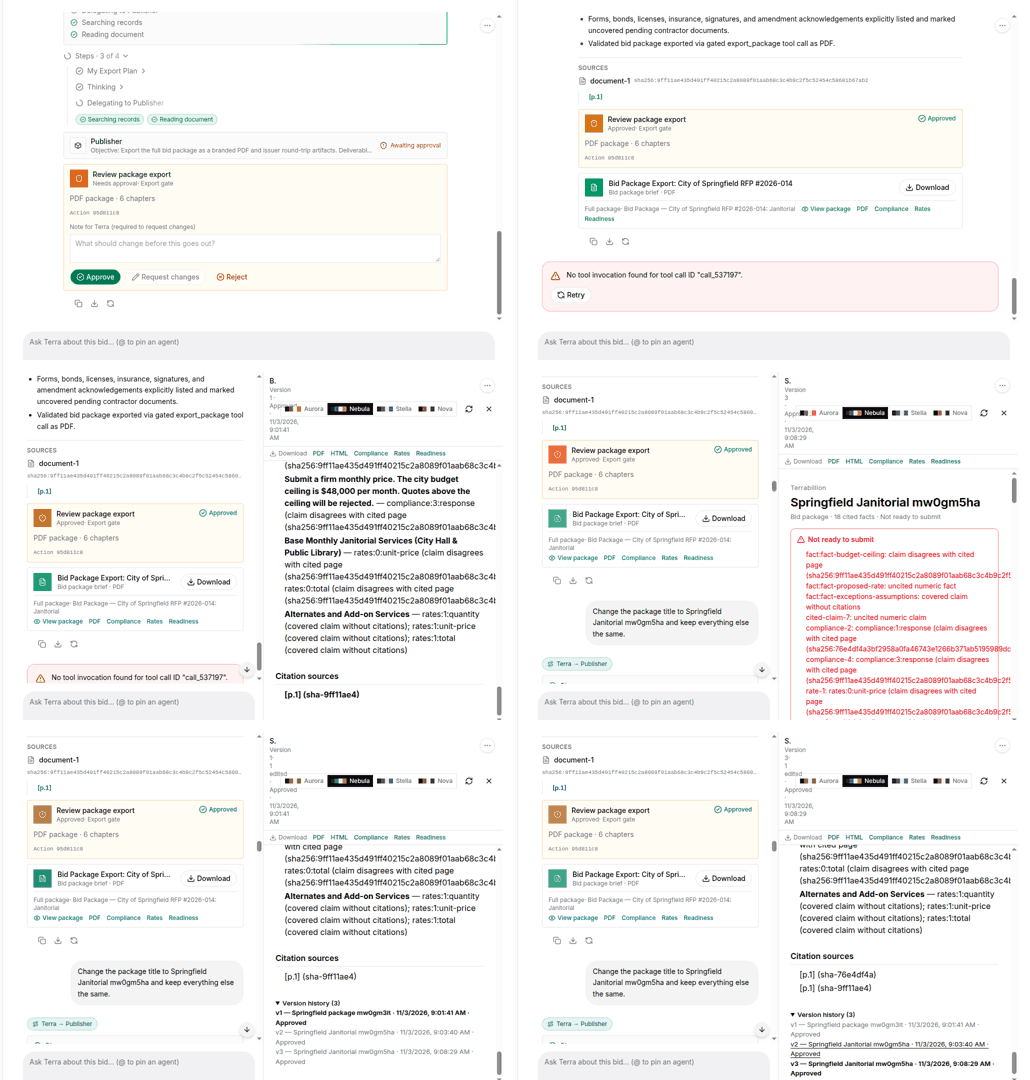
Starting today, Terra hands you a finished bid package instead of a chat transcript. Ask for the package, approve it, and it lands in your library as an artifact: versioned, cited, and downloadable as PDF, HTML, or XLSX. Every edit stores a new version. Every claim carries a citation you can click. Nothing downloads until a human says so.

The package is the product
A transcript is evidence of a conversation. A bid package is evidence of a bid. The difference is what artifacts close: when the publisher finishes, Terra stores the validated package — facts, tables, claims, citations, readiness ledger — as a versioned document you can reopen months later and get exactly what you approved.
Downloads stay locked behind approval. Before you approve, the viewer shows what is ready and what is still missing; after you approve, PDF, HTML, and XLSX unlock together. The lock is the point. A package that can leave the building without a signature is a liability with nice typography.
Versions you can trust
Bid packages get edited. Deadlines move, amendments land, estimators change their minds. Each revision stores a complete new version with its own citations, and the viewer shows what changed: edited facts carry a visible marker, and the version history opens any stored version exactly as it was.
This matters most when something goes wrong. If a number looks off in version 4, you can open version 2 and see what it said and which source page it cited — no archaeology through chat scrollback, no wondering whether the model silently rewrote a requirement.
Citations that resolve
Every citation marker in the viewer is a button. Click [p.3] and the sources list jumps to the supporting passage: document version, page, and quoted text. Facts, table cells, and supporting details all resolve the same way.
The honest half of citations is saying what is missing. Requirements the evidence does not support stay marked as uncovered — named, counted, and carried into the readiness ledger — instead of being papered over with confident prose. A package that tells you what it could not verify is worth more than one that pretends it verified everything.

Steering, not prompting
Two interaction changes ship with artifacts. First, a bare "prepare my bid package" no longer fires blind: Terra asks three quick questions — which solicitation, what package shape, how the deadline should drive sequencing — then builds from your answers. Skip the card and it builds a generic package; answer it and the package starts closer to submittable.
Second, packages are mentionable. Type @ in any chat to pin an artifact by name; same-thread mentions attach the package as revision context, and mentions from another conversation route you to the chat that owns it, since revisions can only happen where the package was built.
Built from fifty real packages
The publisher was retuned against a stratified study of fifty real P&A bid submissions plus a vendor supplement: what sections winning packages actually carry, where compliance matrices live, how pricing tables are shaped, and what "ready to submit" looks like to a buyer. The guidance is prompt-level, versioned with the run, and recorded per package — no silent behavior changes between your draft and your final.
The study also corrected our own bias: the first sample leaned too heavily on solicitations rather than responses. The supplement fixed that. We would rather rebuild a corpus than ship guidance tuned on the wrong genre.
Try it on your next bid
Open Terra, drop in a solicitation, and ask for the full package. Approve the export, pick a theme, click a citation. If the readiness ledger names something missing, that is the feature working — fill the gap and revise. Your library keeps every version, and each one is one click from the sources behind it.
More blog posts to read
Bid alerts are now instant
New matching packages now trigger an alert within a minute of hitting the queue, with contractor-fit scoring attached.
The era of superintelligence: Terra, our agentic SI for P&A bidding
AI answers questions. Terra carries the bid across the finish line: eight specialized agents, citations on every claim, and a human signature on every price.
Orphan-well intel, monthly
Contact sales